UX Research · Thomas Jefferson University

TJU Course
Registration

BannerWeb works. Students don't.

A field research study into why course registration fails students at the exact moment they need clarity most.

The problem

No description.
Just a question mark.

The workaround

Every student
built their own system

bannerweb.jefferson.edu/ssb/bwskfreg.P_AltPin
Add or Drop Classes
Registration Status
Student Schedule
Fee Assessment
Week at a Glance
⚠ Financial hold on account. Contact Student Accounts before registering.
Add Classes — Spring 2025
CRN
Course
Title
Info
24891
HCIM 501
Health Informatics
?
24917
HCIM 520
UX Research Methods
?
24902
HCIM 510
Data Systems Design
?
Course description unavailable — contact your advisor or visit the university website.
Spring 2025 Registration Plan.xlsx
Spring 2025
Prereqs
⚠ Conflicts
Advisor Notes
CRN
Course
Days/Time
Professor
Prereq?
Open?
24891
Health Informatics
MW 9–10:20
Prof. K — good reviews
None req'd
✓ 18 left
24917
UX Research
Prof. R — emailed
24902
Data Systems
TR 1–2:20
Prof. M — unknown
⏳ Waiting on advisor re: prereqs for 520. Sent Mon, it's now Wed. Section has 6 seats left — if it fills before she replies, I'm stuck.
100%
of observed students kept a doc like this open alongside BannerWeb
longer than expected average registration time
Every student. Every program. Same wall.
UG
Under-
graduate
GR
Graduate
Student
TR
Transfer
Student
Arrives at
BannerWeb Registration
?
No course description No prerequisites explained · No advisor available · No way forward
This is why we decided to solve it.
The moment

This is why we
decided to act

UX Research · Thomas Jefferson University

BannerWeb works.
Students don't.

A field research study into why course registration fails students at the exact moment they need clarity most and what a better system could look like.

RoleUser Researcher
ScopeField Research
PlatformBannerWeb · Desktop
TypeAcademic Project
01 Context

The system is functional.
The experience is broken.

BannerWeb allows students to search, add, and drop courses. Technically, it works. But in practice, students find it confusing, stressful, and completely disconnected from how they actually make decisions about their education.

This research project set out to understand why the experience feels broken and to propose a direction that makes course registration feel less like a bureaucratic task and more like a supported academic decision.

8+
students observed during live registration sessions
3×
longer than expected average time to complete registration
100%
of observed students needed external help at least once
02 Research Question

One question guided everything.

After initial observation, the research question crystallised around a single reframe not just what's wrong, but what a better system could actually feel like.

How Might We

How might we improve TJU's course registration process to make it more intuitive, less burdensome, and genuinely supportive of academic decision-making?

03 Research Objectives

Five questions.
One broken system.

Each objective was designed to uncover a different layer of the registration experience from individual mental models to institutional failure points.

01
Understand the mental model students bring to registration what do they expect vs. what they actually find?
02
Identify specific friction points in the BannerWeb flow through field observation and think-aloud sessions.
03
Understand the role of advisors and support staff where do students turn when the system fails them?
04
Explore what a holistic support system could look like integrating advising, scheduling, and registration in one place.
05
Propose a future-state direction grounded in actual student behaviour not assumed pain points.
04 Research Methods

Three methods.
One broken system.

Research was conducted across three distinct approaches capturing perspectives from institutional leadership, students in the field, and the university's own documentation.

METHOD 01
Stakeholder Interviews
12 in-depth interviews conducted with program heads, student advisors, and members of the education committee mapping the institutional view of registration friction.
METHOD 02
Pretzel Over Thought Event
Spoke with 50+ students on campus during a live campus event gathering candid, unprompted views on the BannerWeb registration process in a natural setting.
METHOD 03
Desk Research
Studied the full university catalogue, advising documentation, and institutional materials understanding the system as it was designed, not just how it was experienced.
12
stakeholders interviewed program heads, advisors, and education committee members
50+
students spoken to at the Pretzel Over Thought campus event
Pretzel For Your Thought Field Event
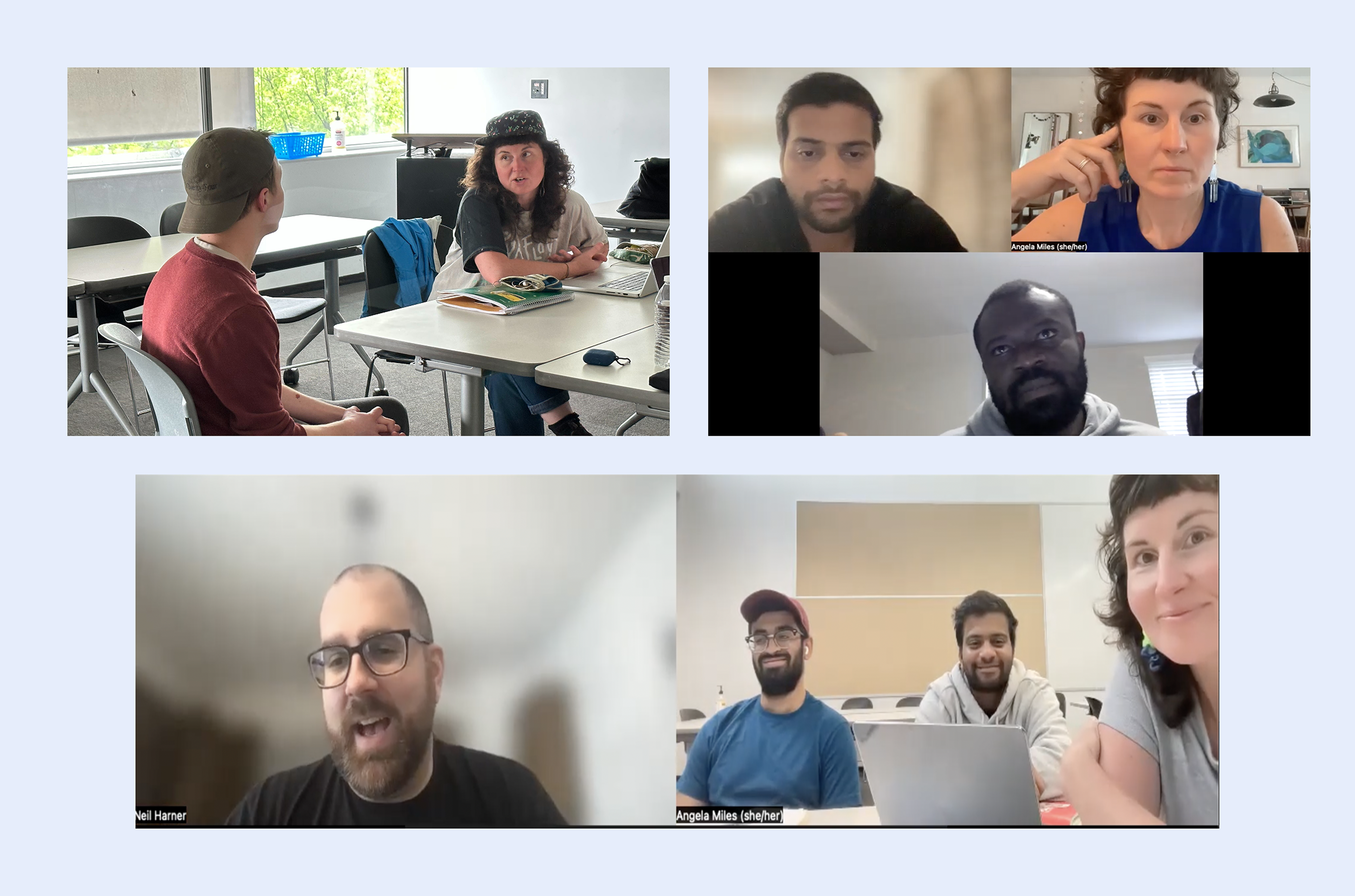
Pretzel For Your Thought campus event

The Pretzel For Your Thought event gave us access to students in an unguarded, natural context not a lab, not a scheduled session. By meeting people where they already were, we heard perspectives that a formal interview would never surface. Most students hadn't consciously labelled registration as a problem. They'd normalised it. The event made those invisible frustrations visible.
Stakeholder Interview Snippets
Interview snippets from stakeholder sessions

Interviews with program heads, student advisors, and education committee members revealed a consistent tension: institutional stakeholders understood the system's limitations but felt constrained by legacy infrastructure and resource limitations. Advisors, in particular, described registration season as a period of damage control fielding the same interface questions week after week, with no systemic fix in sight.

Academic Catalog TJU 2022 2023

Background research into the TJU Academic Catalog, graduate course descriptions, and institutional correspondence helped frame the right questions for user interviews ensuring the study could gather relevant and actionable insights rather than surface-level complaints.

TJU Academic Catalog 2022–2023
Catalog cover
Pending upload
Supporting Evidence Desk Research
Supporting evidence — desk research

University catalogues and advising documentation painted a picture of a system designed with good intentions but built for administrative efficiency not student comprehension. Course codes, prerequisite logic, and section numbering were all structured around backend processes rather than how a student thinks when choosing a class.

04b Desk Research Finding

The infrastructure gap between
undergrad and graduate.

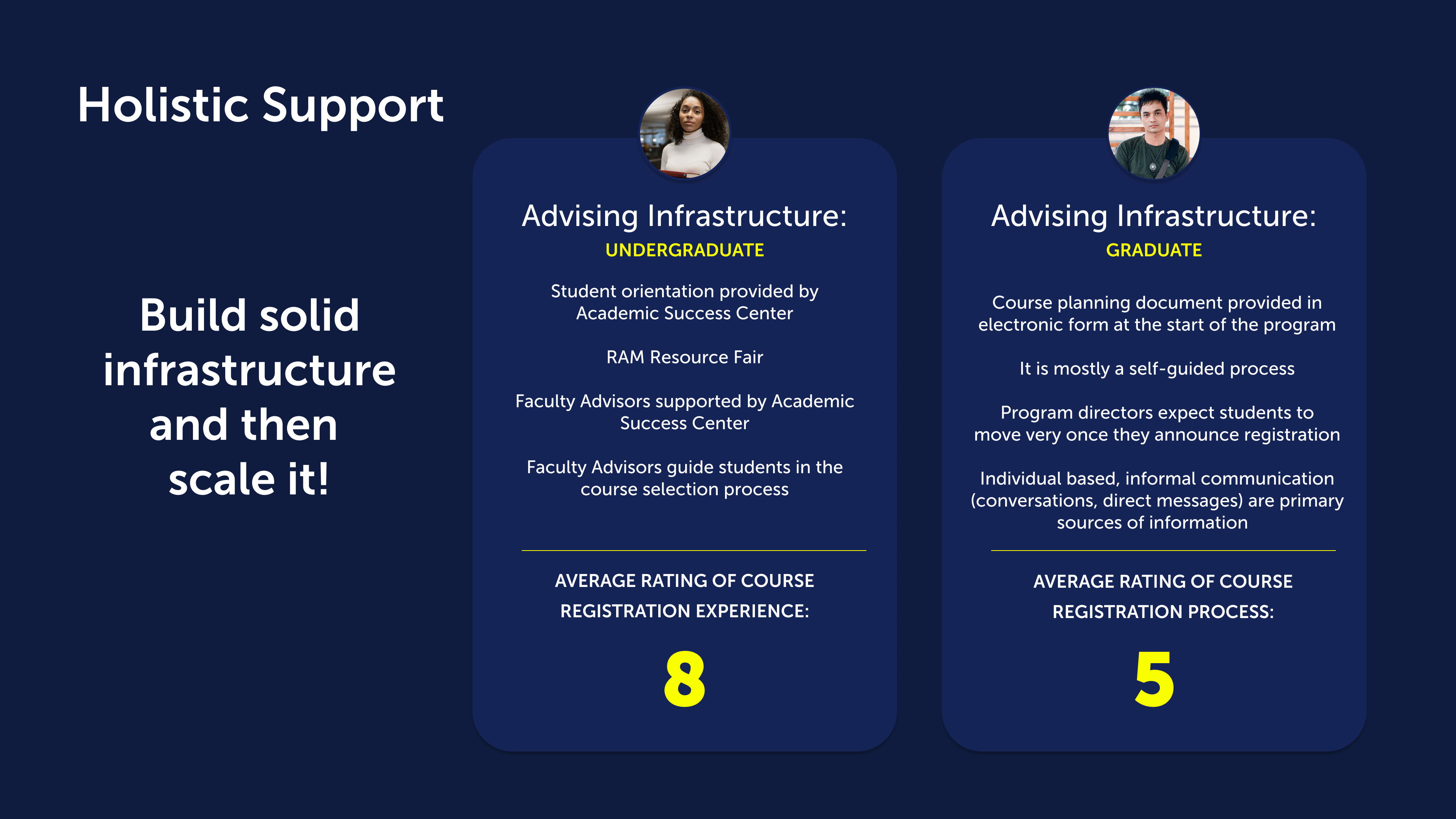
Desk research into the university catalogue revealed a stark difference in advising support undergraduate students benefit from structured, layered guidance, while graduate students are largely left to navigate registration alone.

Undergraduate
Advising Infrastructure
Student orientation provided by Academic Success Center
RAM Resource Fair held at the start of each semester
Faculty Advisors supported by Academic Success Center
Faculty Advisors actively guide students through course selection
Avg. rating course registration
8/10
Graduate
Advising Infrastructure
Course planning document provided in electronic form at program start
Largely a self-guided process minimal structured support
Program directors expect students to act immediately when registration opens
Informal channels conversations and direct messages are the primary source of information
Avg. rating course registration
5/10

Key implication: Graduate students encounter registration with far less institutional scaffolding making every piece of friction in BannerWeb hit harder. Building holistic support means closing this infrastructure gap first, then scaling it.

05 Key Insights

Three findings that
changed the direction.

The most revealing moments weren't when users complained they were when users shrugged. Every workaround had become invisible to them.

"Students don't fail at course registration because they're careless they fail because the system wasn't designed around how they think."
01
#1 Finding
Students arrived with a mental model built around course names and professor recommendations not the prerequisite codes and section numbers BannerWeb requires.
02
Biggest Surprise
Every student observed used external tools spreadsheets, notes apps, group chats to plan before touching BannerWeb. The system was the last step, not the first.
03
Key Pivot
Advisors were absorbing enormous friction from the broken system. They spent most of their time explaining the interface not advising academically. The system was failing staff too.
06 Personas

Three students.
Three breaking points.

These archetypes emerged directly from field research real patterns from real sessions, not invented profiles.

MR
Persona 01
Maya R.
First-year · Age 18 · Undergraduate
First-time registrant
Situation

Arrived with a handwritten list of course names from orientation only to find BannerWeb requires CRN codes she's never heard of. Has no idea what half the fields mean or whether she qualifies for the courses she wants.

Biggest Struggle

Understanding prerequisite logic. Can't tell if she's eligible for a course without emailing an advisor and waiting two days for a reply by which point the section is already full.

In her words
"I've been on this page for 20 minutes and I still don't know if I can take this class."
JT
Persona 02
James T.
Third-year · Age 21 · Undergraduate
Experienced but frustrated
Situation

Has registered five times. Built his own spreadsheet system to plan before touching BannerWeb but still finds himself re-entering the same data from scratch each semester with no continuity.

Biggest Struggle

Schedule conflicts. Has to manually cross-check every course time because BannerWeb surfaces no warnings he only finds out about clashes after he tries to submit.

In his words
"I've done this 5 times. It shouldn't still take me two hours."
DK
Persona 03
Dr. Karen D.
Academic Advisor · 8 years at TJU
Staff absorbing system friction
Situation

Registration week means 40+ emails before Monday morning most aren't academic questions, they're interface questions. She spends the majority of her time explaining what a CRN number is.

Biggest Struggle

Scaling her time. Every interface question she fields is time taken away from the actual academic guidance students need and the system gives her no tools to reduce the volume.

In her words
"My job is to guide students academically. Instead I'm explaining what a CRN number is."
07 Current vs. Future State

From fragmented flow
to holistic system.

After synthesising field findings, the gap between what exists and what's needed became impossible to ignore.
Current state What it is
Fragmented + confusing
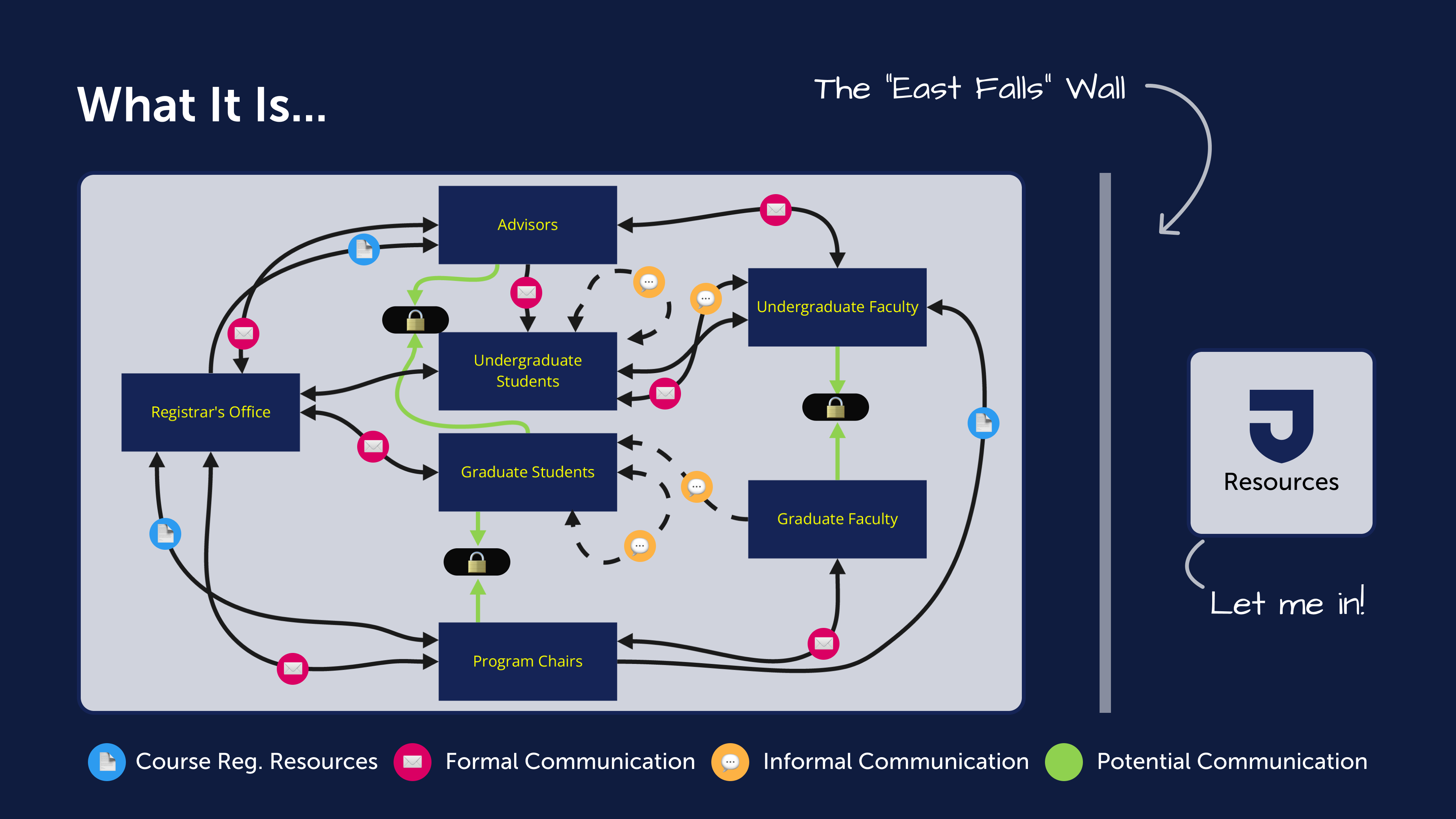
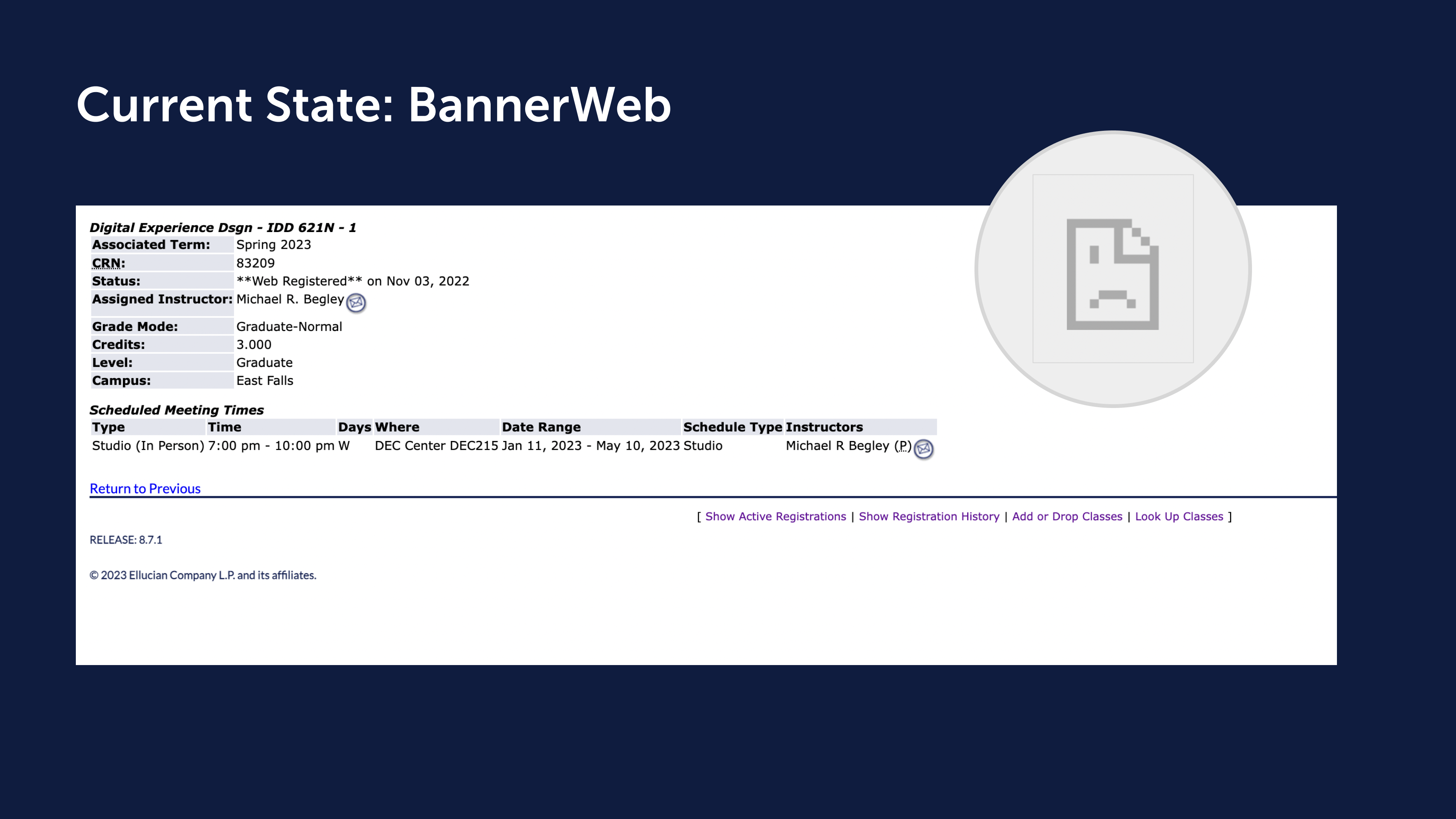
Current BannerWeb registration flow

The current BannerWeb experience is a walled system resources exist on the other side but students can't access them without navigating a maze of codes, locked pages, and prerequisite barriers. The "East Falls Wall" became a recurring metaphor in research: students know help exists, but the system blocks them from reaching it without an advisor's intervention.
Students plan externally, then manually re-enter everything into BannerWeb
No conflict detection students discover time clashes after the fact
Prerequisites shown as codes, not plain language requires advisor translation
Advisors flooded with interface questions instead of academic guidance
Future state What it could be
Integrated + supportive
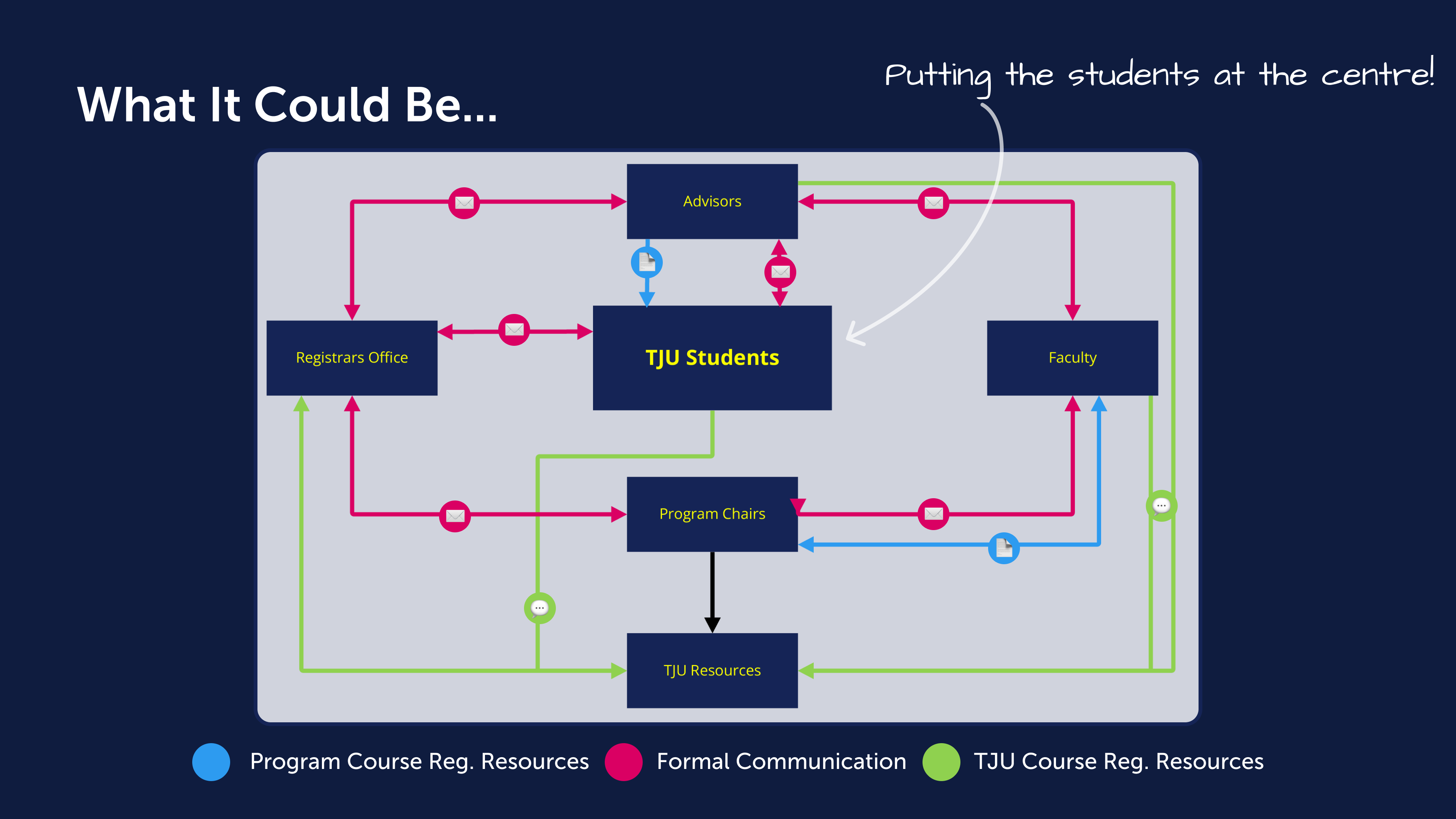
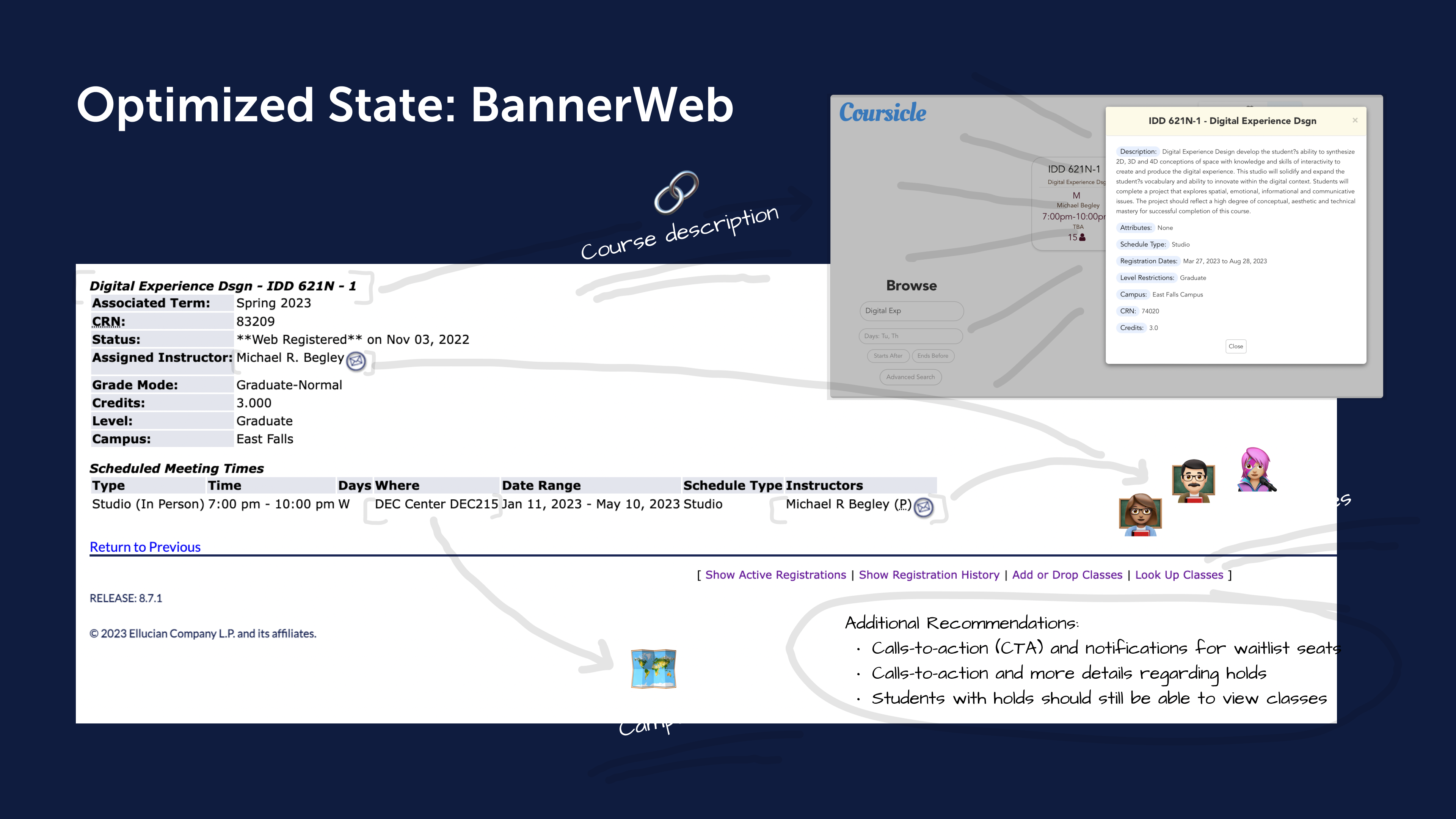
Proposed optimised registration flow

The optimised state keeps BannerWeb's core infrastructure but layers in everything students actually need course descriptions surfaced inline via Coursicle integration, faculty profiles visible at the point of selection, a campus map for room context, and proactive CTAs for waitlists and holds. Students with holds can still browse they're no longer locked out of information.

Course descriptions surfaced inline no external lookup needed
Faculty profiles visible at the point of course selection
Campus map integrated for room and location context
CTAs and notifications for waitlist seats and hold details
Students with holds can still view and browse classes
08 Key Findings

Two systemic problems.
Two design directions.

Each finding pointed at a structural failure not a user error. The proposed directions address root causes, not symptoms.

Finding 01
Students were doing all their planning outside the system
Build the planning layer into the registration system. A visual schedule builder that lets students drag, drop, and plan before committing then submit directly. Eliminate the external spreadsheet step entirely.
"Every student we observed had an external document open alongside BannerWeb. That's a system design failure, not a user behaviour problem."
Finding 02
Advisors were absorbing interface friction the system should solve
Build infrastructure so advisors don't need to be involved in basic navigation. Plain-language prerequisites, real-time eligibility checks, and conflict detection surface the right information at the right moment.
"Every minute an advisor spends explaining a CRN number is a minute they're not helping a student make better academic decisions."
09 Current & Proposed

What exists today.
What we're proposing.

The proposed changes don't require rebuilding BannerWeb from scratch they layer the information students actually need on top of existing infrastructure, at the exact moments they need it most.
Current state
BannerWeb as it is
Current BannerWeb state

a CRN, a time slot, an instructor name. No course description. No way to understand what you're signing up for without leaving BannerWeb entirely. The broken document icon where course info should be is the most honest summary of the problem.
No inline course description students must search externally
No faculty profile instructor is just a name and an icon
No campus map room codes are meaningless without context
Students with holds are blocked from even viewing options
Proposed state
BannerWeb optimised
Proposed optimised BannerWeb

The proposed state layers the missing context directly into BannerWeb a Coursicle integration surfaces the full course description inline, faculty profile avatars link to instructor pages, a campus map resolves room codes into real locations, and students with holds can still browse and plan even if they can't yet register.

Course description surfaced inline via Coursicle no external lookup
Faculty profiles visible at point of selection
Campus map integrated for room and building context
CTAs for waitlist seats and hold resolution
Students with holds can view and plan not locked out
Reflection

The best research reveals what
users have accepted as normal.

Every student who opened a spreadsheet alongside BannerWeb had stopped seeing it as a problem. My job as a researcher was to see it for them, name it, and make the case that it didn't have to be that way.

← Back to Work View Presentation →