UX Case Study · E-Commerce

Hair Food

Making hair care effortless to buy.

Enhancing the Hair Food website with e-commerce functionality to improve user experience and drive business growth.
UX Case Study · E-Commerce

Making hair care
effortless to buy.

Enhancing the Hair Food website with e-commerce functionality to improve user experience and drive business growth.

RoleProduct Designer
ToolsFigma · Figjam
PlatformWeb · Mobile
TagsE-Commerce · UX
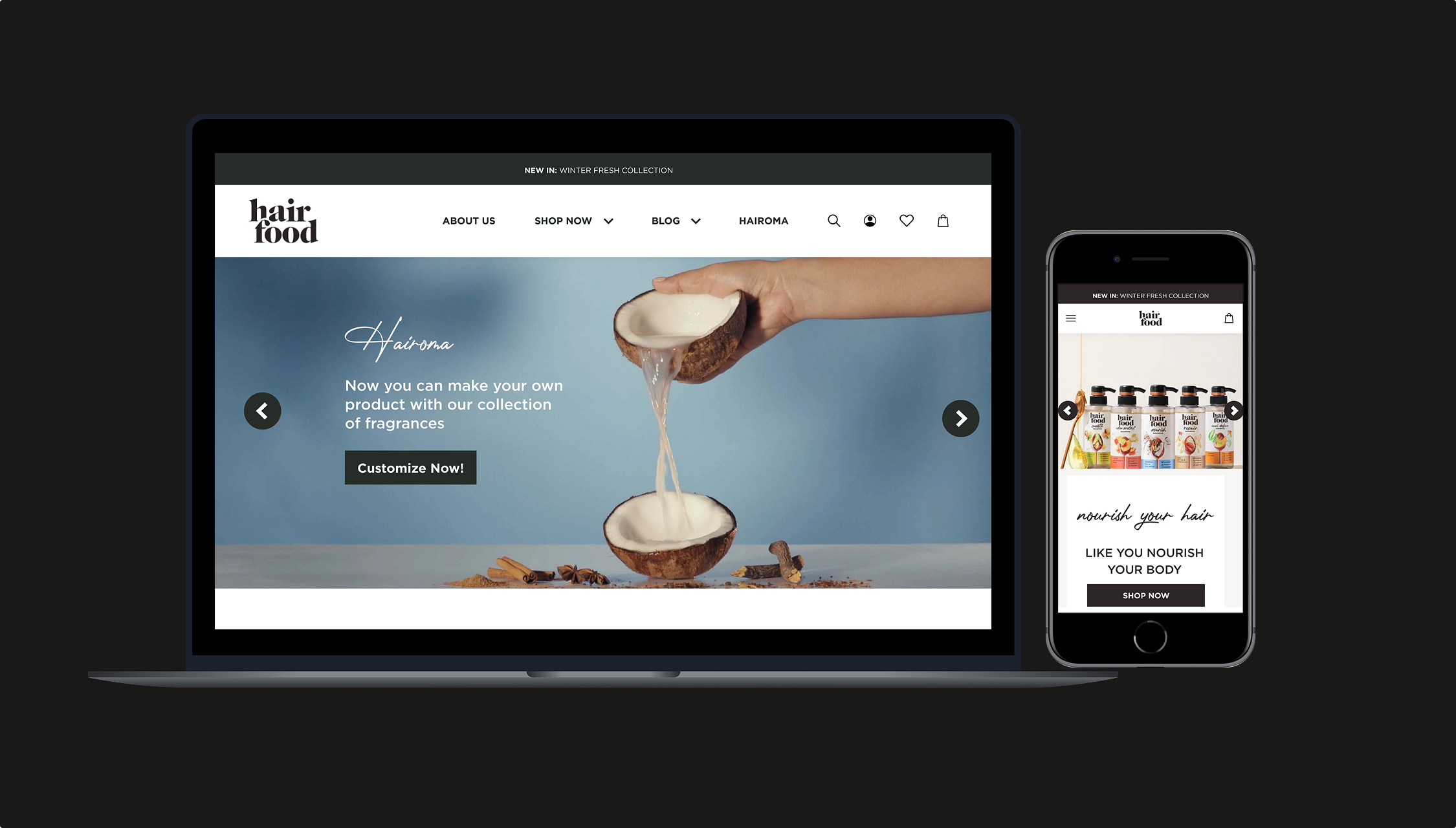
Hair Food product mockup
01 — Overview

The goal: give Hair Food
a real place to sell.

The Hair Food website lacked a functioning e-commerce layer. Users could browse products but had no seamless path to purchase — a critical gap for a brand competing in a crowded beauty market.

The brief was to add e-commerce functionality and improve the overall shopping experience to increase conversion and brand loyalty.

How can we offer Hair Food customers a convenient and secure online shopping experience while also encouraging increased shopping frequency?

— Design Challenge
02 — Research

What users told us
before we touched Figma.

User interviews and usability tests surfaced three recurring pain points — each one a direct obstacle to purchase.

78%
of participants preferred viewing ingredients before selecting hair care products
$3.45
average online spend per purchase among female hair care shoppers in the US
Finding 01
No clear purchase pathway
Users had a strong initial interest to register and engage with the Hair Food brand in-app, but struggled to find where and how to complete a transaction.
Critical
Finding 02
Ingredient transparency matters
Participants wanted to maintain established hair care routines. Seeing the full ingredients list before adding to cart was a deciding factor in purchase intent.
Insight
Finding 03
$3.45 spend signals price sensitivity
Comparing bundled solutions and showing clear price-per-value framing could push users past hesitation at checkout.
Insight
03 — Process

Four phases.
No guesswork.

A double-diamond approach: understand the problem deeply before designing the solution.

01
Discover
  • Primary Research
  • Prepare project plans
02
Define
  • Secondary Research
  • User Interviews
  • Google Survey
  • Customer Journey Map
  • Empathy Map
03
Design
  • Sitemap
  • User Flow
  • Wireframes
  • Prototyping
04
Evaluate
  • Usability Testing
  • Design System Documentation
04 — Research Deep Dive

Understanding the thought process
behind a hair care purchase.

To understand how people buy hair care products online we ran a series of primary research activities followed by a competitive analysis of direct and indirect players.

Primary Research

Users often had strong personal interest in trying new products to improve hair health. However competing with in-store discovery — being able to smell and feel textures — proved to be the main barrier to online conversion.

Comparing prices across popular online platforms was a habitual behaviour. Users would not purchase without first confirming a product was well reviewed and reasonably priced relative to the ingredients offered.

Secondary Research

During an ingredient-first scroll test to figure out what triggers new users to begin their purchase flow, participants consistently paused on product detail pages only when ingredient lists were prominently displayed above the fold.

Analysing competitor conditions and ingredient combinations also affirmed that Hair Food's natural ingredient story is a genuine differentiator — but one that was buried deep in the existing product pages, limiting its conversion potential.
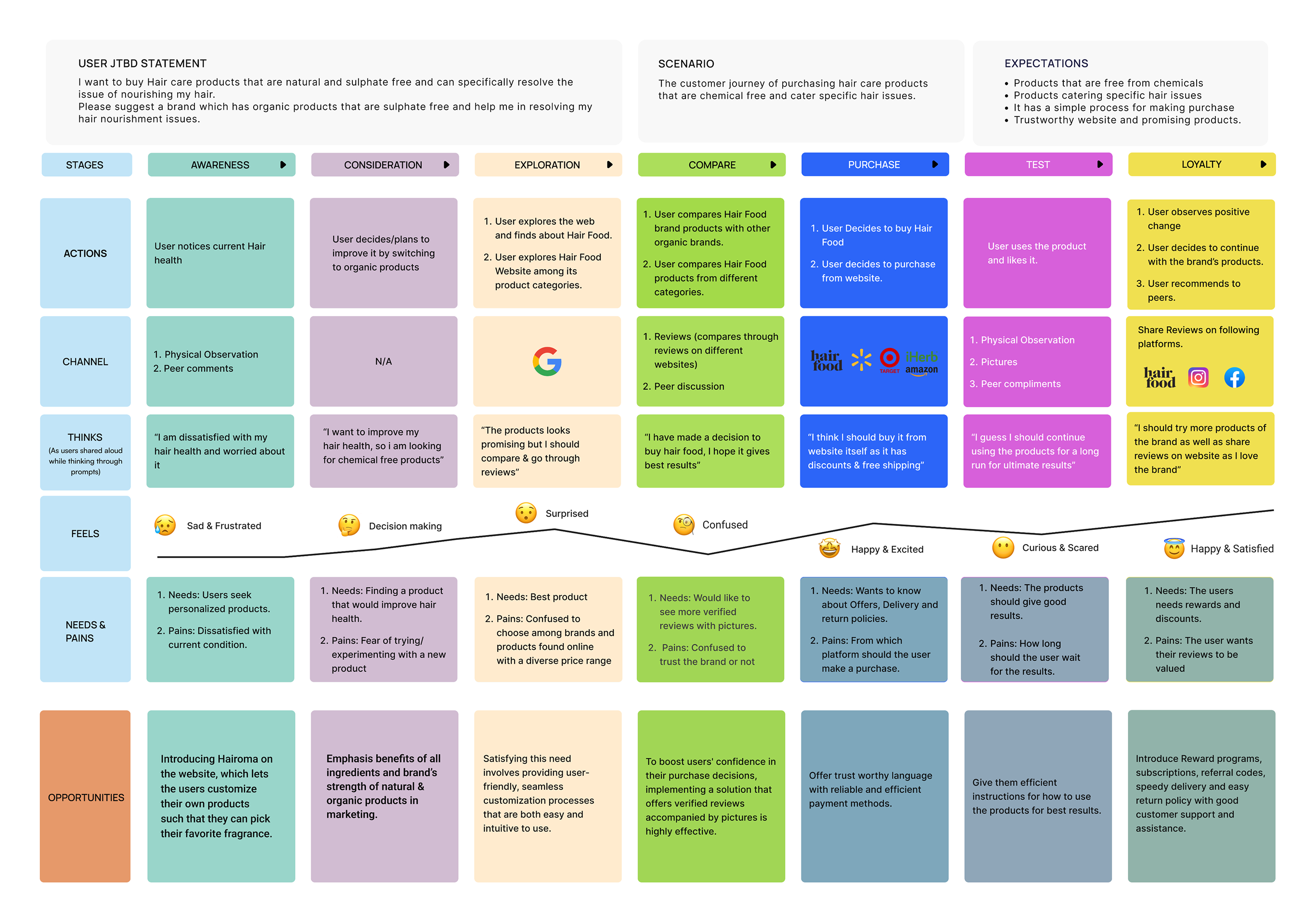
User journey map
05 — Solutions

Two problems.
One cohesive experience.

Solution 01

Ingredient Finder

A guided quiz helps users identify their preferred fragrance families and ingredient combinations, then surfaces the right products — reducing decision fatigue at the top of the funnel.

Solution 02

Streamlined Checkout

A redesigned cart and checkout flow removes unnecessary friction steps, surfaces bundle savings, and adds a persistent "your routine" shelf to encourage repeat purchase.

New Innovation · 05b
Hairoma

A fragrance customisation system that lets users blend two scents at a chosen ratio and see exactly what product they're creating — before they buy. It turns passive browsing into a personalised ritual.

The Hairoma flow

Pick. Blend.
Make it yours.

A four-step fragrance customisation system. Every step is skippable and reversible — users stay in control without ever feeling committed too early.
10
Natural scent families
Unique combinations possible
1
Tap to reorder your blend
01
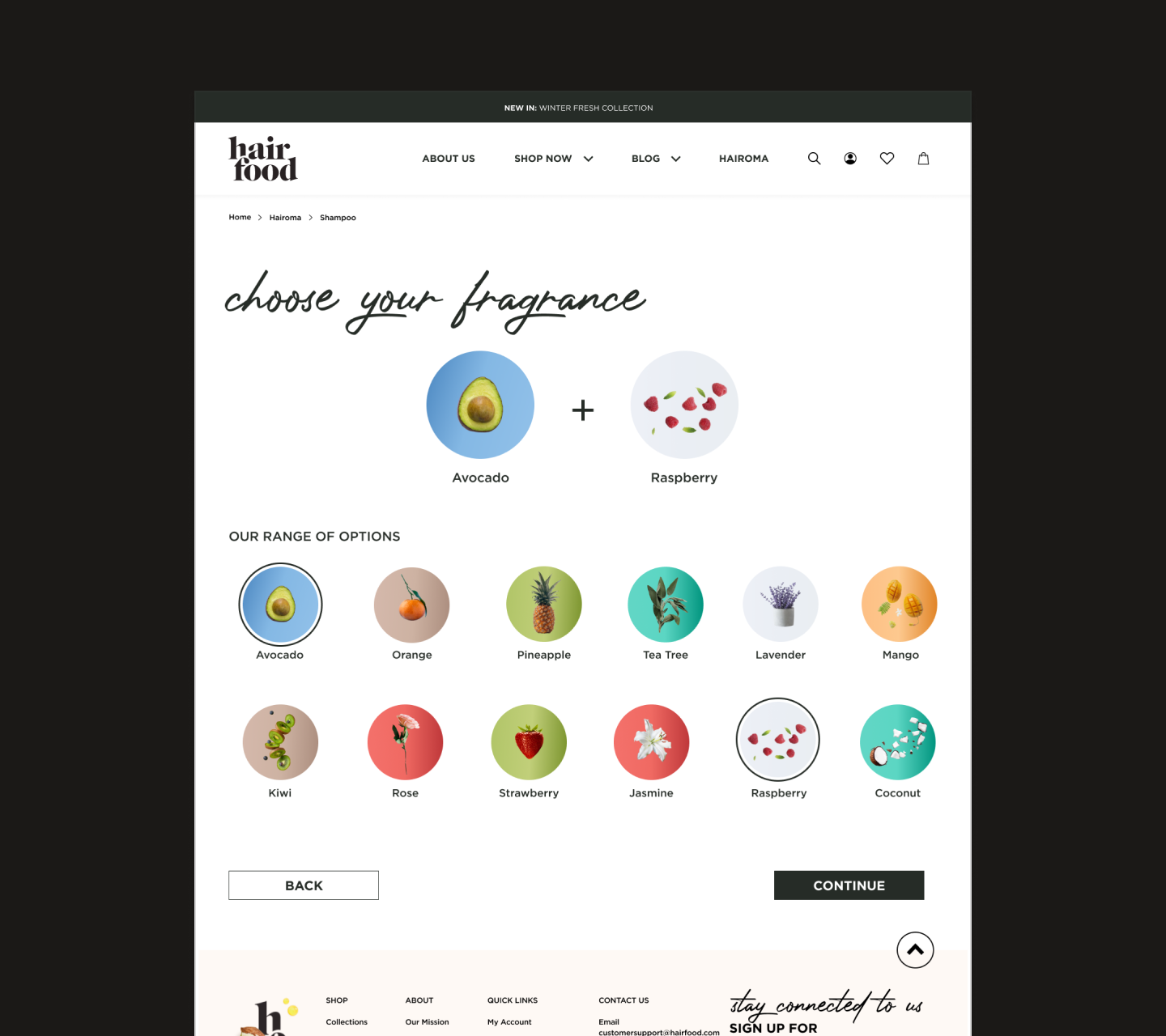
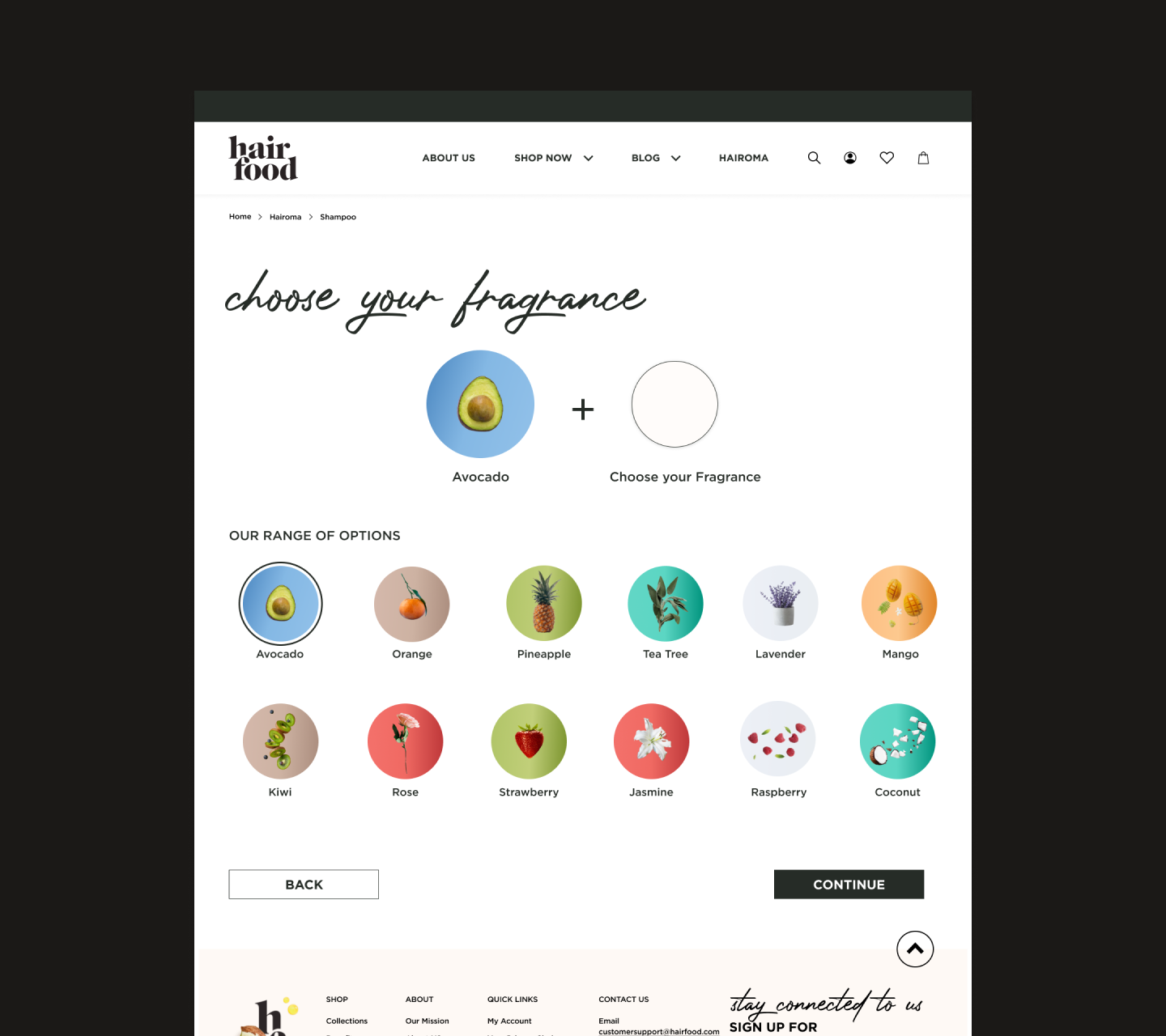
Choose your first fragrance
Pick from 10 natural scent families — avocado, mango, coconut, jasmine, and more. Ingredient icons explain what each does for your hair.
02
Add a second scent
Layer a complementary fragrance to build your unique combination. A pairing guide highlights which scents work best together.
03
Set the ratio
A simple slider lets you set the dominant note — 60/40, 50/50, or anything in between. The preview updates in real time.
04
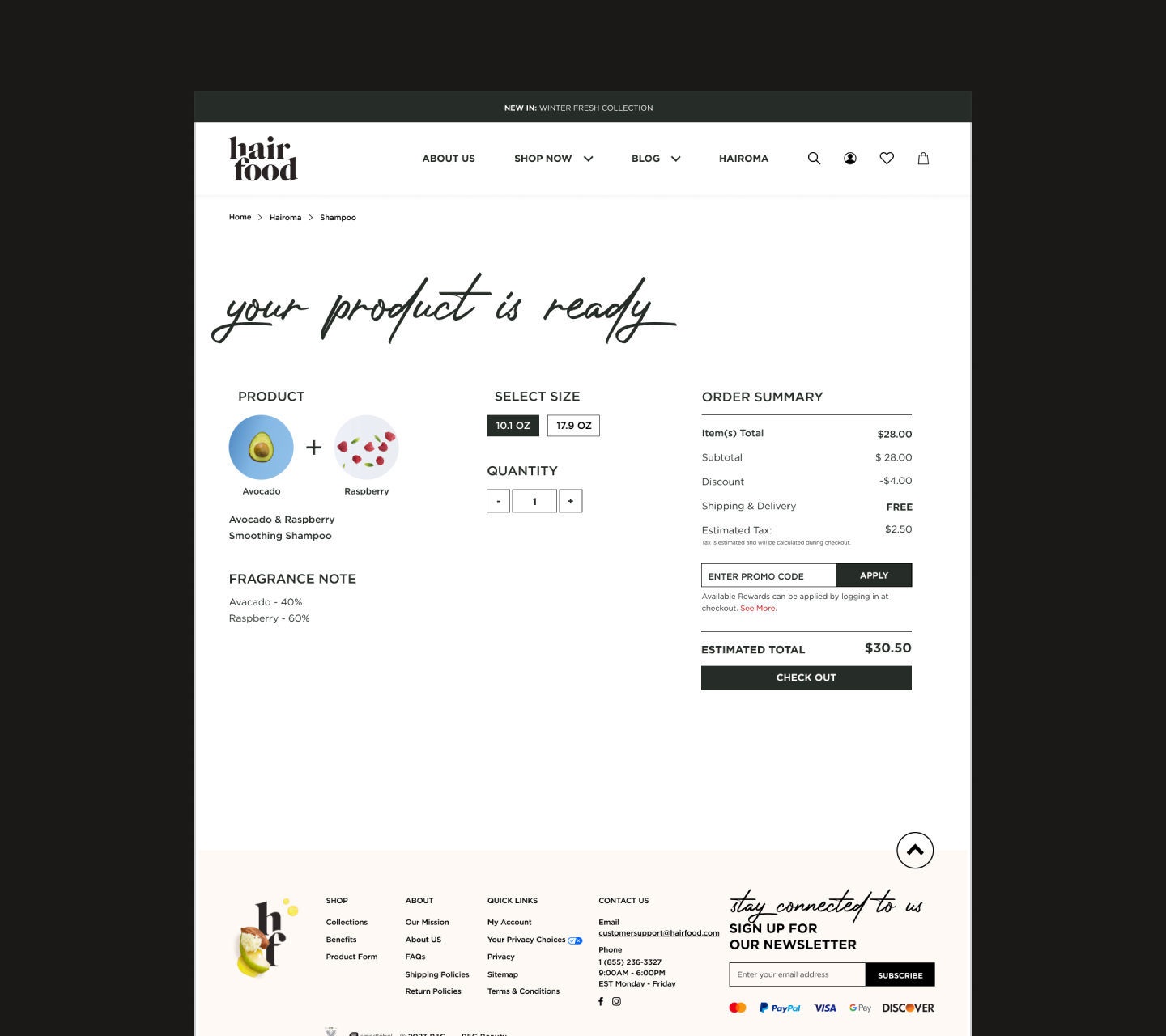
Your product is ready
A full order summary shows your custom blend, size, fragrance note, and price — one tap to checkout with your formula saved.
Reduces decision fatigue
Instead of browsing dozens of pre-made SKUs, users build one product. Fewer options, more ownership of the outcome.
Drives repeat purchase
A saved blend means users return to reorder their exact formula — not restart discovery from scratch every time.
A genuine differentiator
No competing hair care brand offers this level of fragrance customisation. It gives Hair Food a story no competitor can copy.
06 — Features

What the redesign
actually delivers.

Fragrance Finder Quiz
Users answer a short series of scent preference questions. The quiz maps their answers to Hair Food's product families and surfaces a personalised recommendation — lowering the effort to choose the right product.
Ingredient Spotlight
Key ingredients are displayed prominently on product cards and detail pages, with plain-language explanations of what each does for different hair types. Reduces the need to leave the site to research.
Gender-Adaptive Flow
An inclusive onboarding step lets users indicate their hair goals rather than their gender, tailoring category navigation and editorial content accordingly. Broadens the addressable audience.
Routine Builder
Showing users the combined benefits and price of a shampoo + conditioner + treatment bundle directly on the PDP increases average order value while making the purchasing decision feel curated rather than upsold.
07 — Screens

From wireframe
to final design.

Every key flow went through at least two rounds of iteration before high-fidelity work began. Click any screen to expand.
hairfood.com
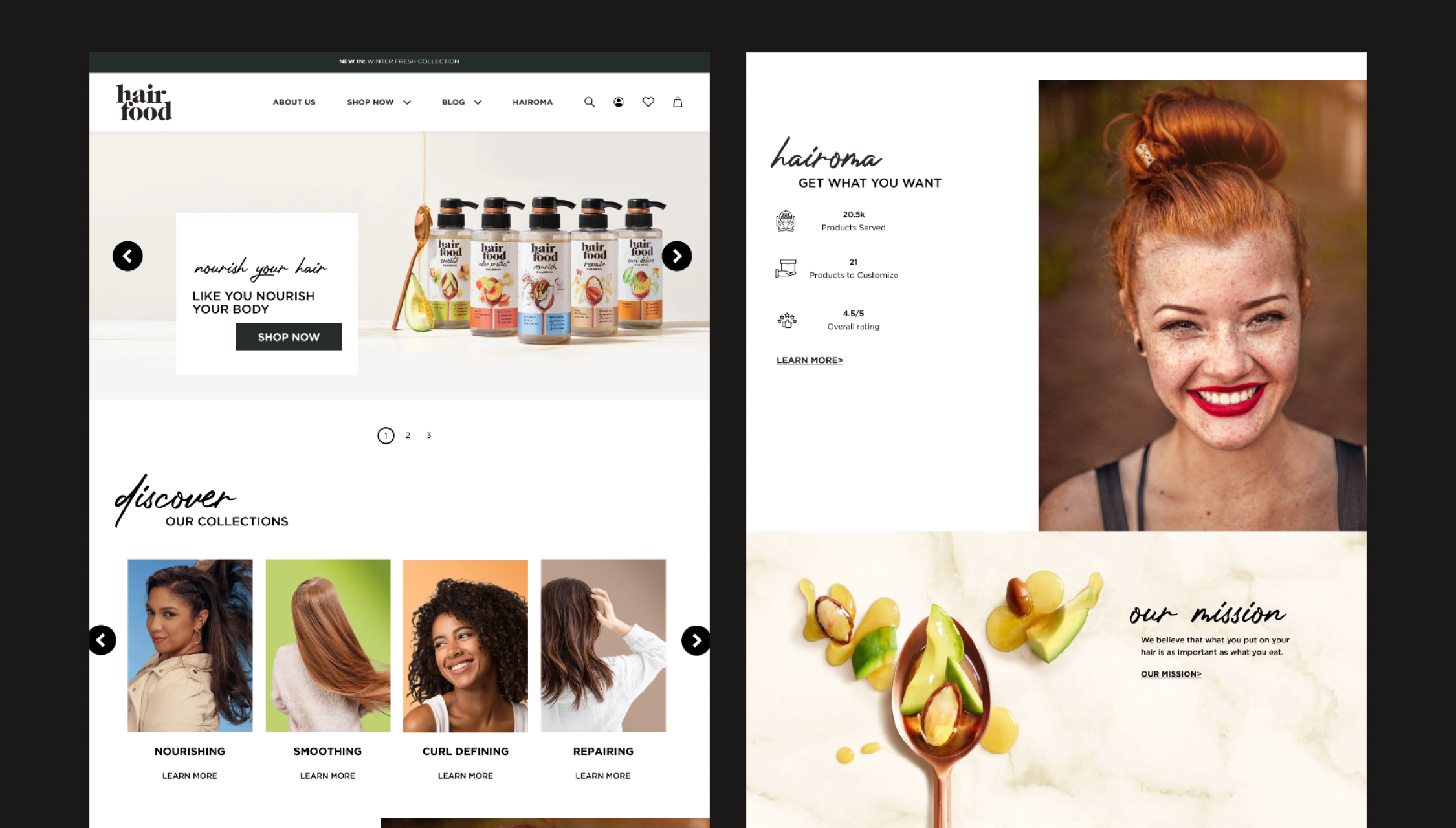
Hair Food homepage
Homepage · Hairoma entry point
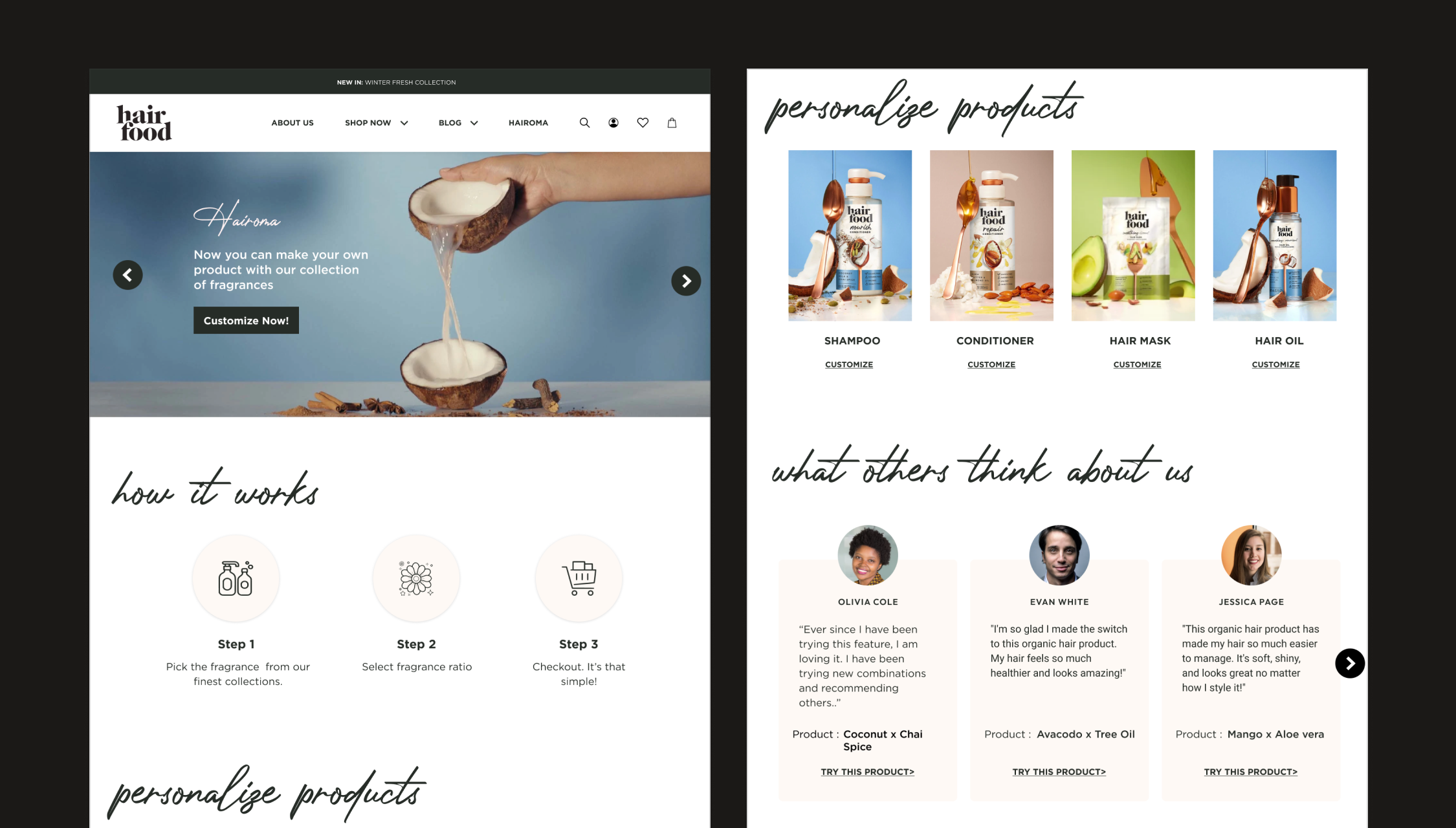
Hairoma landing
Hairoma · Customisation landing
Choose second fragrance
Hairoma · Choose your fragrance
hairfood.com/hairoma/checkout
Your product is ready
Hairoma · Your product is ready
08 — Iteration

What we broke.
What we fixed.

Round 1
Quiz felt like a blocker, not a helper
Users perceived the Fragrance Finder as a mandatory gate before browsing. We made it skippable and repositioned it as a shortcut, increasing opt-in rate significantly.
Fixed
Round 2
Ingredient labels were too technical
Participants unfamiliar with hair care chemistry felt alienated. We introduced plain-language benefit tags alongside each ingredient name (e.g. "seals moisture" instead of "cetyl alcohol").
Redesigned
Round 3
Routine Builder pricing was confusing
Showing per-item price alongside bundle price created cognitive load. Simplified to a single clear "bundle saves $X" callout with individual items collapsible below.
Validated
09 — Outcomes

Results from
usability testing.

After two rounds of moderated testing with target users, the redesigned flows showed measurable improvement across every key metric.

92%
Task completion rate for adding a product to cart
72%
Reduction in drop-off at the ingredient detail step
27
Participants across testing rounds
5
Screens redesigned end-to-end